Table of Contents
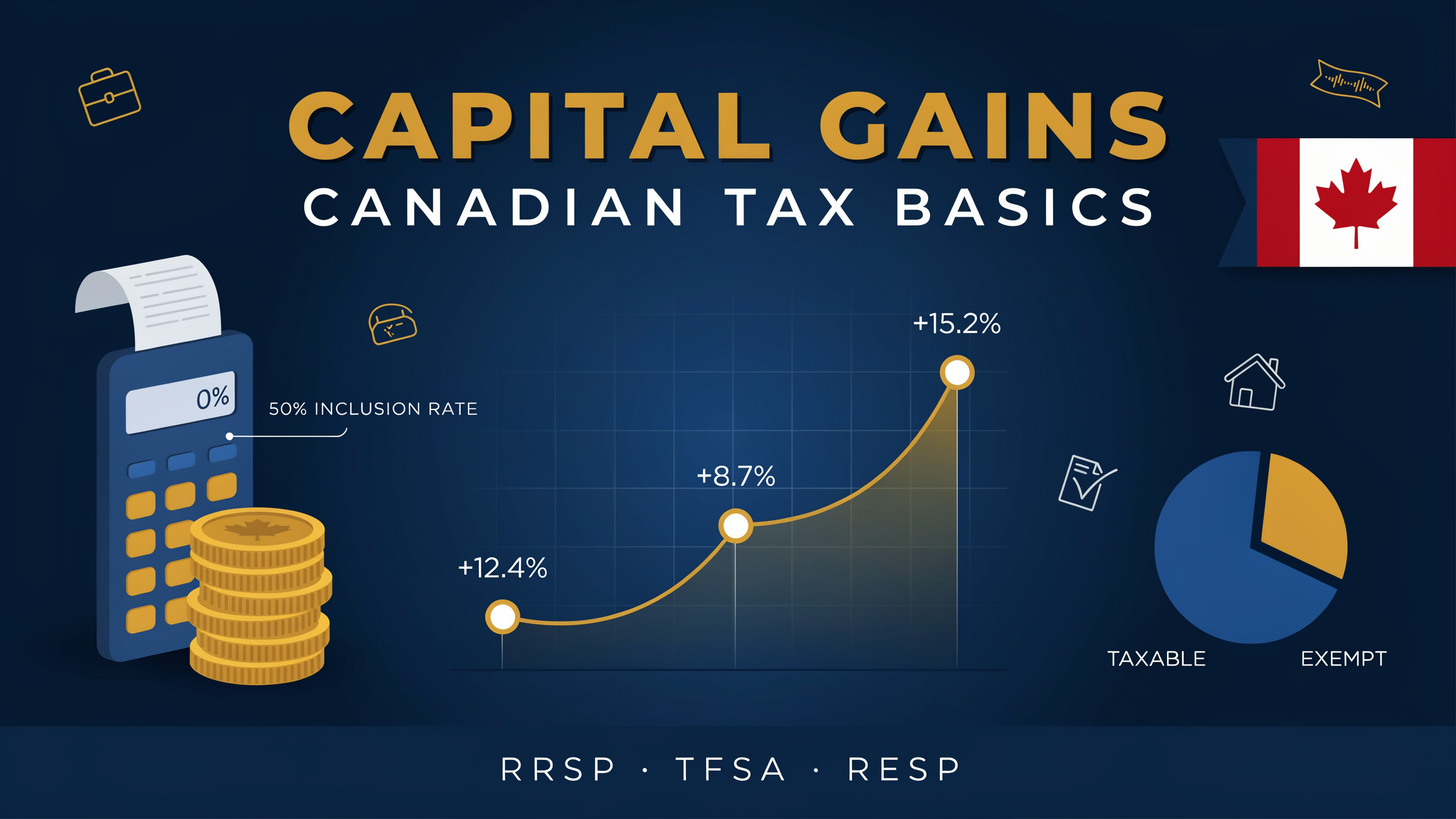
Capital gains tax in Canada for the 2024 tax year applies a 50% inclusion rate to the gain on most dispositions of capital property — meaning half your profit is taxable at your marginal rate — while the Lifetime Capital Gains Exemption shelters up to $1,016,813 of gains on qualified small business corporation shares or qualified farm/fishing property (with an increased $1,250,000 limit applying to dispositions after June 24, 2024).

On this page
- What Is Capital Gains Tax in Canada?
- The 2024 Inclusion Rate: One-Half
- How to Calculate Your Capital Gain
- What Qualifies as Capital Property
- Exemptions That Reduce or Eliminate Tax
- Lifetime Capital Gains Exemption (LCGE)
- Principal Residence Exemption
- Capital Losses and Tax-Loss Harvesting
- Reporting on Your Tax Return
- Planning Strategies to Minimize Tax
- Frequently Asked Questions
The federal budget of June 24, 2024 proposed increasing the inclusion rate to two-thirds (66.67%) for individuals with more than $250,000 of annual capital gains, effective for dispositions after June 24, 2024. That measure was subsequently reversed in January 2025. For the 2024 tax year, the inclusion rate remains one-half (50%) for all individuals. The LCGE limit for qualified small business corporation shares and qualified farm/fishing property increased to $1,250,000 for dispositions after June 24, 2024, while the prior limit of $1,016,813 applies to dispositions before June 25, 2024.
What Is Capital Gains Tax in Canada?
When you dispose of capital property — shares, real estate (other than your principal residence), cryptocurrency, mutual fund units, or an interest in a business — for more than your adjusted cost base (ACB), the difference is a capital gain. Canada taxes only a portion of that gain, called the taxable capital gain, determined by the inclusion rate. The rest is a non-taxable capital gain. Capital losses can offset taxable capital gains in the same year, or be carried back three years or forward indefinitely.
The 2024 Inclusion Rate: One-Half
The inclusion rate has been 1/2 (50%) since February 2000 and remains at 1/2 for the 2024 tax year. This means if you realize a $100,000 capital gain, $50,000 is included in your income and taxed at your marginal rate. The June 24, 2024 budget proposed raising the rate to 2/3 for the portion of an individual's annual capital gains exceeding $250,000, with a $250,000 annual threshold that would be shared with a spouse or common-law partner. That proposal was included in Bill C-69 but was not enacted before Parliament was prorogued, and the government confirmed in January 2025 that the increase would not proceed. For filing your 2024 return, use 1/2 for all capital gains and losses.
How to Calculate Your Capital Gain
Capital gain = Proceeds of disposition − Adjusted cost base (ACB) − Outlays and expenses. Proceeds are what you received (sale price, fair market value on a deemed disposition, or compensation for expropriated/destroyed property). ACB is generally your purchase price plus acquisition costs (commissions, legal fees, transfer taxes). Outlays and expenses are costs to sell (commissions, legal fees, advertising, fixing-up costs). For identical properties acquired at different times (e.g., shares bought in multiple lots), CRA requires the average cost method: total cost of all units divided by total units gives the ACB per unit.

What Qualifies as Capital Property
Capital property includes: publicly traded shares, mutual fund and ETF units, cryptocurrency (Bitcoin, Ethereum, etc.), rental or investment real estate, private company shares, bonds and debentures (other than prescribed debt obligations), units of a trust, goodwill, and listed personal property (art, jewelry, rare books, stamps, coins). Property held for personal use (your car, household furniture, a cottage used only personally) is personal-use property — gains are taxable but losses are not deductible. If you buy and sell frequently with a profit motive, CRA may classify you as a dealer and treat gains as business income, fully taxable at 100% inclusion.
Exemptions That Reduce or Eliminate Tax
Several provisions can reduce or eliminate the taxable capital gain:
- Principal residence exemption — shelters the gain on a home you designate as your principal residence for each year you owned and ordinarily inhabited it (see next section).
- Lifetime Capital Gains Exemption (LCGE) — shelters up to the annual limit on gains from qualified small business corporation shares or qualified farm/fishing property (see below).
- Donations of publicly traded securities — donating shares directly to a registered charity eliminates the capital gain entirely while generating a donation credit for the full fair market value.
- Intergenerational transfers — Form T2066 election can defer gain on transfers of QSBCS or QFFP to adult children.
- Qualifying business transfers (QBT) and qualifying cooperative conversions (QCC) — Forms T24EOT and T25QCC provide deductions for transfers to employee ownership trusts or worker cooperatives.
Lifetime Capital Gains Exemption (LCGE)
The LCGE is a cumulative lifetime limit that shelters capital gains on dispositions of qualified small business corporation shares (QSBCS) and qualified farm or fishing property (QFFP). The limit is indexed to inflation annually.
| Period | Lifetime limit | Deduction limit (50% of lifetime limit) |
|---|---|---|
| 2024 before June 25 | $1,016,813 | $508,418 |
| 2024 after June 24 | $1,250,000 | $625,000 |
| 2023 | $917,190 | $485,595 |
To qualify as a QSBCS, the shares must be of a Canadian-controlled private corporation (CCPC) where, throughout the 24 months before disposition, more than 50% of the fair market value of the corporation's assets were used principally in an active business carried on primarily in Canada, and at the time of disposition, all or substantially all (generally 90%) of the fair market value of the assets were used in such an active business. The shareholder must have owned the shares (or substituted shares) throughout the 24-month period. Gains sheltered by the LCGE reduce the deduction limit available for future dispositions.
If you hold QSBCS and are planning a sale, the timing relative to June 24, 2024 matters. Dispositions after that date access the higher $1,250,000 limit. Also, "purification" — moving excess cash or passive investments out of the operating company before sale — is often needed to meet the 90% active-asset test at disposition. Start purification well in advance; a company purified the month before due diligence rarely satisfies the look-back tests.
Principal Residence Exemption
You can designate one property per family unit (you, spouse, common-law partner, children under 18) per year as your principal residence. The exemption formula is: Gain × (1 + years designated) / years owned. The "+1" rule allows you to shelter the gain for the year of acquisition and the year of disposition simultaneously if you acquire a new principal residence in the same year you sell the old one. You must report the disposition on Schedule 3 and file Form T2091 (or T2091-IND) to claim the exemption. A property you rent out part-time may qualify if you occupy it for part of the year and do not claim capital cost allowance on it.
Capital Losses and Tax-Loss Harvesting
Allowable capital losses (50% of the capital loss) offset taxable capital gains in the current year. Excess losses create a net capital loss that can be carried back three years (to recover tax paid) or carried forward indefinitely. The superficial loss rule denies a loss if you or an affiliated person (spouse, corporation you control, TFSA, RRSP) acquires the same or identical property within 30 calendar days before or after the disposition and still owns it 30 days after the disposition. The denied loss is added to the ACB of the repurchased property. Tax-loss harvesting — deliberately selling losers before year-end to offset gains — is legitimate if you respect the 30-day rule and don't repurchase identical property in a registered account.
Reporting on Your Tax Return
Capital gains and losses are reported on Schedule 3 (Capital Gains or Losses) and carried to line 12700 of the T1 return. The taxable capital gain (after the 50% inclusion rate) goes on line 12700; allowable capital losses go on line 12700 as a negative amount. Net capital losses carried back require Form T1A (Request for Loss Carryback). Foreign property with a cost over $100,000 CAD at any time in the year must be reported on Form T1135 (Foreign Income Verification Statement) — this includes foreign stocks, crypto on foreign exchanges, and foreign real estate. Mutual fund and trust distributions of capital gains are reported on T3 slips (box 21) and flow through to your Schedule 3. Employee stock options with a 50% deduction are reported on T4 slips (box 38/39) and the deduction is claimed on line 24900.
Planning Strategies to Minimize Tax
- Hold for the long term — deferral is the most powerful tool; no tax until disposition.
- Donate appreciated securities — eliminates the gain and yields a credit at your top marginal rate.
- Use the principal residence exemption — designate the property with the highest accrued gain per year of ownership.
- Harvest losses before year-end — respect the 30-day superficial loss rule.
- Consider a holding company — intercorporate dividends are tax-free; passive income inside a holdco is taxed at ~50% (investment income) but can be deferred. The small business deduction may be eroded if passive income exceeds $50,000/year.
- Stock options — the 50% deduction for qualifying options effectively matches the capital gains inclusion rate.
- Estate planning — on death, there is a deemed disposition at fair market value. The LCGE, principal residence exemption, and spousal rollover (tax-deferred transfer to spouse) are the primary tools to manage the terminal tax bill.
What is the capital gains inclusion rate for 2024 in Canada?
The inclusion rate for 2024 is 1/2 (50%). A proposed increase to 2/3 for individuals with more than $250,000 of annual capital gains was announced in the June 24, 2024 budget but was not enacted and was reversed in January 2025. Use 50% for all 2024 dispositions.
How much is the Lifetime Capital Gains Exemption in 2024?
For dispositions before June 25, 2024, the LCGE limit is $1,016,813 (deduction limit $508,418). For dispositions on or after June 25, 2024, the limit is $1,250,000 (deduction limit $625,000). The limit applies to qualified small business corporation shares and qualified farm or fishing property, and is indexed annually.
Is my principal residence exempt from capital gains tax?
Yes, if you designate it as your principal residence for each year you owned and ordinarily inhabited it. You must report the disposition on Schedule 3 and file Form T2091. Only one property per family unit per year can be designated. The "+1" rule allows overlapping designations in the year you buy and sell.
Can I claim a capital loss on cryptocurrency?
Yes, cryptocurrency is capital property. A loss on disposition creates an allowable capital loss (50% of the loss) that offsets taxable capital gains. The superficial loss rule applies if you repurchase the same cryptocurrency within 30 days, including in a TFSA or RRSP. The denied loss is added to the ACB of the repurchased units.
Do I pay capital gains tax on mutual fund distributions?
Mutual funds and trusts distribute capital gains to unitholders (T3 slip, box 21). You report the distribution as a capital gain on Schedule 3. The fund's adjusted cost base is increased by the amount of the reinvested distribution to avoid double taxation when you eventually sell the units.
What is the superficial loss rule and how does it affect me?
If you sell property at a loss and you or an affiliated person (spouse, controlled corporation, TFSA, RRSP) acquires the same or identical property within 30 days before or after the sale and still owns it 30 days after the sale, the loss is denied. The denied amount is added to the ACB of the repurchased property. Plan your loss harvesting to avoid repurchasing identical property in any account you or your spouse controls for 31 days.
How are capital gains taxed differently from dividends?
Only 50% of a capital gain is taxable (inclusion rate 1/2). Eligible Canadian dividends are grossed up 38% and receive a dividend tax credit, resulting in a lower effective tax rate than the same amount of capital gains for most brackets. Non-eligible dividends are grossed up 15% and have a smaller credit. Capital losses offset capital gains only; dividend tax credits cannot create a refund beyond the tax otherwise payable.
Do I need to file Form T1135 for foreign stocks or crypto?
If the total cost of all specified foreign property exceeded $100,000 CAD at any time in the year, you must file Form T1135. This includes foreign stocks, foreign mutual funds, crypto held on foreign exchanges, foreign real estate (other than personal-use property), and interests in non-resident trusts. The penalty for failure to file is $25/day up to $2,500 per year, higher if gross negligence is found.
For most Canadian investors, capital gains tax is manageable with planning: hold quality assets long-term, use the principal residence exemption, harvest losses deliberately, donate appreciated shares, and consider a holding company if you have significant passive income. The 2024 inclusion rate remains 50%, and the LCGE provides meaningful shelter for business owners and farmers. Every situation differs — whether it's a rental property in Toronto, a stock portfolio in Vancouver, or a family farm in Alberta — so confirm your position with a professional tax accountant before acting. Contact Tax Filings Canada at +1 (416) 619-0068 or info@taxfilings.ca for a free 15-minute consultation, anywhere in Canada.